Trump demands an investigation of the GDP revision, calling earlier figures fake
Trump says pre-midterm growth data from the Commerce Department was deliberately low. Why the BEA raised its estimate to 4.3%, and how unusual the jump was.

What happened
President Donald Trump on Thursday, Nov. 26, 2026, accused the Commerce Department of putting out deliberately low economic growth numbers before the midterm elections and called for an immediate investigation. His complaint is about a GDP revision released Wednesday that raised third-quarter growth to a 4.3% annual rate from the 3.4% first estimate. The government released the update on its regular schedule, and economists say revisions like this are a normal part of how GDP is measured.
Key takeaways
- CNBC found the 0.9-point change ties for 16th among first revisions since 1990 and is the largest since a 1.2-point revision in spring 2020.
- Most of the upgrade came from a revised software price index, which raised the estimate of business investment in software.
- Futures traders put the odds of a Fed rate hike in December near 100%, and the stronger growth number adds to that case, which Trump opposes.
- The Commerce Department and the BEA didn't immediately respond to Axios's requests for comment.
In this article
Published Thursday, Nov. 26, 2026, 2:15 p.m. ET. U.S. stock and bond markets are closed for Thanksgiving.
President Donald Trump spent part of Thanksgiving morning attacking his own government's economic statistics. In posts on Truth Social, he accused the Commerce Department of releasing "fake" growth figures before the midterm elections and said he wants the matter investigated, the Associated Press reported from West Palm Beach, Florida.
The odd part is what set him off. The data in question didn't make the economy look worse. It made it look better.
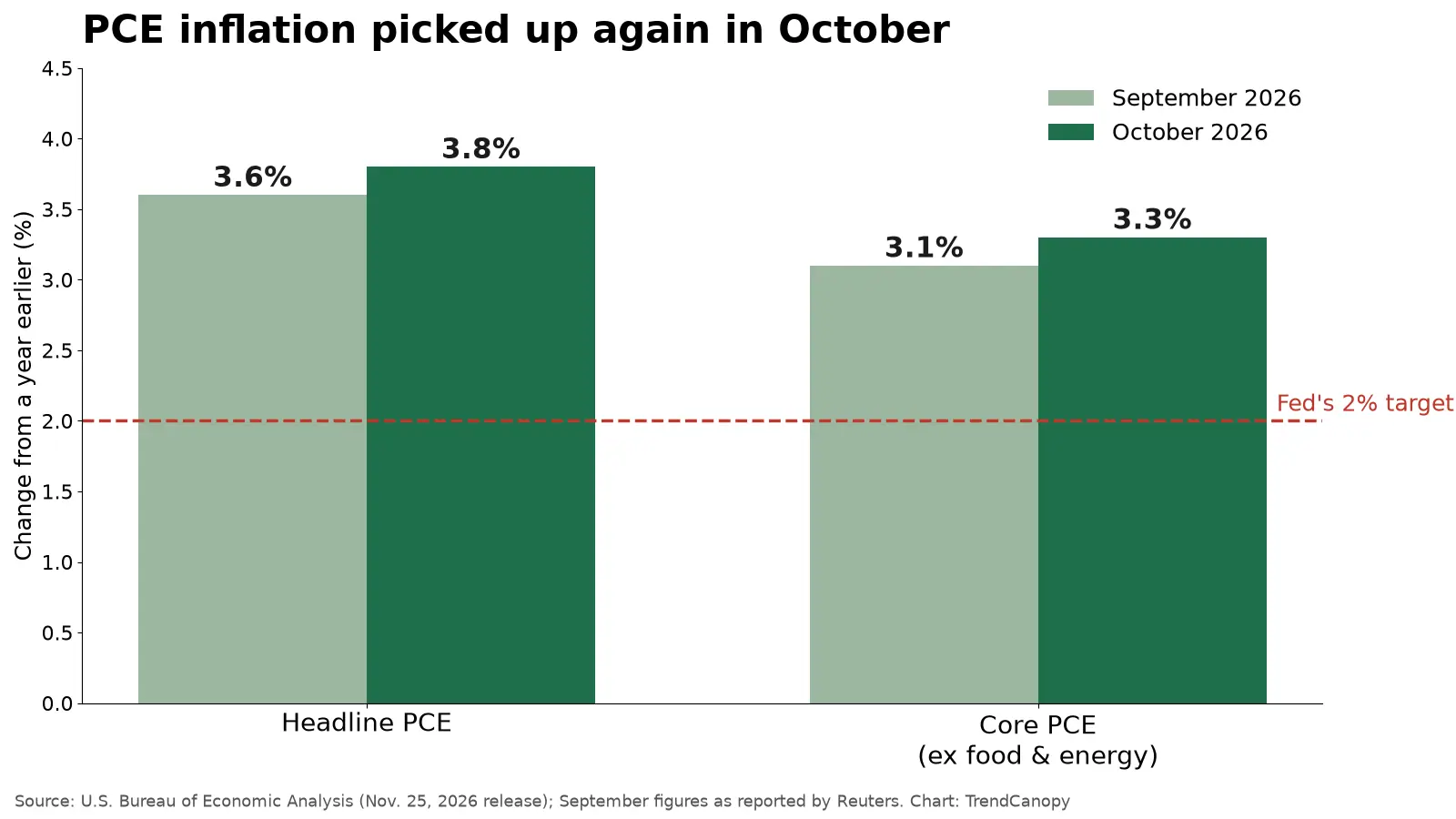
Read also: PCE inflation rises to 3.8% in October as summer GDP growth is revised up to 4.3% · The 10-year Treasury yield tops 5.1% as inflation data lifts bond yields · Bitcoin slides to $65,000, a three-month low, amid ETF outflows
On Wednesday, the Bureau of Economic Analysis raised its estimate of third-quarter growth to a 4.3% annual rate, up from the 3.4% it reported less than a week before Election Day. Trump's argument is that the higher number should have been out before voters went to the polls on Nov. 3, when Democrats flipped both chambers of Congress.
What Trump said about the GDP revision
"I would like to wish a Happy Thanksgiving to even those who issued fake Economic Numbers, just prior to the Election, and corrected them yesterday, three weeks late," Trump wrote, according to CNBC. He called the gap between 3.4% and 4.3% "A RECORD SETTING ERROR" that "should be immediately investigated."
In a second post quoted by Axios, he called it a "massive, and purposeful, error" and asked why the correct number wasn't issued before the election.
The posts quoted so far don't say who would run an investigation or what it would examine. The BEA sits inside the Commerce Department, which is led by Howard Lutnick, one of Trump's closest allies. Neither the department nor the bureau responded right away to Axios.
Was the revision late?
No. The BEA publishes three estimates for every quarter, about a month apart, as more source data comes in. The Nov. 25 release was the second estimate, and it came out on the date the agency had announced in advance, both CNBC and Axios noted.
So the "three weeks late" line doesn't fit how the calendar works. The first estimate is always a rough cut built on partial surveys. The second adds more complete numbers, and a third follows a month later. GDP figures keep getting revised for about five years after that, CNBC said.
How big was the GDP revision?
Bigger than usual, but far from a record.
CNBC ran the numbers. Since 1990, the change from the first to the second GDP estimate has averaged about 0.43 percentage point across 147 quarters, so this week's 0.9-point move was roughly double the norm. It tied with four other quarters and ranked 16th overall. The last larger jump came in the second quarter of 2020, during Trump's first term, when growth was revised by 1.2 points as the economy whipsawed through the pandemic.
Even the first estimate wasn't a weak number. CNBC noted that the 3.4% reading published days before the election beat what economists expected at the time and showed growth speeding up from the spring. The second quarter grew at 2.2%, according to the BEA.
Why the BEA raised third-quarter growth
The agency spelled out the reasons in its technical notes. The largest change was in business investment, specifically software. After the Bureau of Labor Statistics revised its producer price index for software publishing, the BEA recalculated how much real investment companies had made in software, and that number went up.
Consumer spending was raised too. Updated Census Bureau retail figures pushed up spending on goods, led by pharmaceuticals, software and computer accessories, and gasoline. Spending on services moved the other way. New quarterly survey data lowered the estimate for hospitals, nursing homes and outpatient care.
Other measures rose along with headline GDP:
- Current-dollar GDP, which isn't adjusted for inflation, grew at a 6.2% rate, up from 5.6%.
- Real final sales to private domestic purchasers, a gauge of underlying demand the Fed watches, grew 5.8%, up from 4.9%.
We broke down Wednesday's release, and the hotter inflation report that came out the same morning, in PCE inflation rises to 3.8% in October as summer GDP growth is revised up to 4.3%.
Why economists worry about attacks on the data
This isn't the first time Trump has gone after the people who produce federal statistics. Last year he fired the commissioner of the Bureau of Labor Statistics over revisions to jobs numbers, Axios noted. The AP said Trump has repeatedly tried to cast doubt on economic data that doesn't match his claims of a historic boom.
Businesses, investors and the Federal Reserve all lean on these figures. Statistical agencies work under long-standing rules meant to keep career staff away from political pressure, and Axios warned that allegations like Thursday's could revive fears of interference in data that guides trillions of dollars in decisions.
There's a real debate among economists about making early estimates faster and more accurate. That's a different claim from saying statisticians cooked the numbers on purpose, and Trump hasn't offered evidence for the second one.
What it could mean for interest rates
The irony for the White House is that a stronger economy strengthens the case for higher interest rates, which Trump opposes.
Traders see close to a 100% chance that the Fed raises rates at its Dec. 8-9 meeting, and they expect another increase in January, CNBC reported, citing the CME FedWatch tool. Jim Baird, chief investment officer at Plante Moran Financial Advisors, said after Wednesday's release that the economy's resilience "gives the Fed an even stronger case for further rate hikes," according to CNBC.
For a recap of where rates stand now, see The Fed holds rates at 3.75%-4% in a 10-2 vote, with Lisa Cook dissenting.
Markets won't get a chance to react until Friday. Stock exchanges are closed for Thanksgiving and reopen for a shortened session that ends at 1 p.m. ET.
When the next GDP estimate comes out
The BEA's third and final pass at third-quarter growth is due Wednesday, Dec. 23, at 8:30 a.m. ET. If the software investment that drove this week's upgrade holds up, the 4.3% figure could stand, or move again in either direction. Whether anyone at Commerce opens the investigation Trump asked for is a separate question, and as of Thursday afternoon, nobody had said.
Frequently asked questions
- Why did Trump call the GDP numbers fake?
- Trump says the first estimate of third-quarter growth, 3.4%, was purposely set too low before the Nov. 3 midterms, which Democrats won. After the BEA raised it to 4.3% on Nov. 25, he called the earlier figure fake and asked for an immediate investigation. He has offered no evidence of tampering.
- Why was third-quarter GDP revised up to 4.3%?
- The BEA said fuller data raised its estimates of business investment and consumer spending. The biggest change came from software, after the Bureau of Labor Statistics revised a software price index. Retail sales data pushed up spending on goods, while new survey data lowered health care spending.
- Is a 0.9-point GDP revision a record?
- No. CNBC found it tied for 16th among first revisions since 1990, matching four other quarters. It's the largest since the second quarter of 2020, when growth was revised by 1.2 points, and roughly double the 0.43-point average change.
- When is the next GDP report?
- The BEA's third estimate of third-quarter GDP is scheduled for Wednesday, Dec. 23, 2026, at 8:30 a.m. ET, alongside the November personal income report. The first estimate for the fourth quarter comes in early 2027.
Sources
- Trump calls the pre-election GDP figures 'fake' and demands an investigation of Commerce Department · Associated Press, Nov. 26, 2026
- Trump demands probe into 'record setting error' after third-quarter GDP data gets massive revision higher · CNBC, Nov. 26, 2026
- Trump demands investigation into GDP data revisions · Axios, Nov. 26, 2026
- GDP (Second Estimate) and Corporate Profits, 3rd Quarter 2026 · U.S. Bureau of Economic Analysis, Nov. 25, 2026
Tags
- #GDP revision
- #Trump GDP investigation
- #Third-quarter GDP
- #Bureau of Economic Analysis
- #Commerce Department
- #Economic data
- #Federal Reserve
About the author
Founder and editor
Marcia Reid is the founder and editor of TrendCanopy, where she reviews and edits every story.
Spotted an error? Read our corrections policy or contact us. Last reviewed November 26, 2026.
Related stories


Trending now
Tech ·
FIFA confirms a cyberattack gave hackers access to personal and business informationSports ·
Lions and Bears open the NFL Thanksgiving games with first place in the NFC North at stakeLifestyle ·
Lowe's opens Black Friday Doorbusters to members online while stores close for ThanksgivingNews ·
Judge blocks FCC's early ABC license review, citing likely Trump retaliationMoney ·
SpaceX and Elon Musk pledge about $17.8 billion in stock to kids' Trump Accounts