PCE inflation rises to 3.8% in October as summer GDP growth is revised up to 4.3%
The Fed's preferred price gauge hit 3.8% and core PCE beat forecasts at 3.3%, while third-quarter growth was marked up. What it means for a December rate hike.
What happened
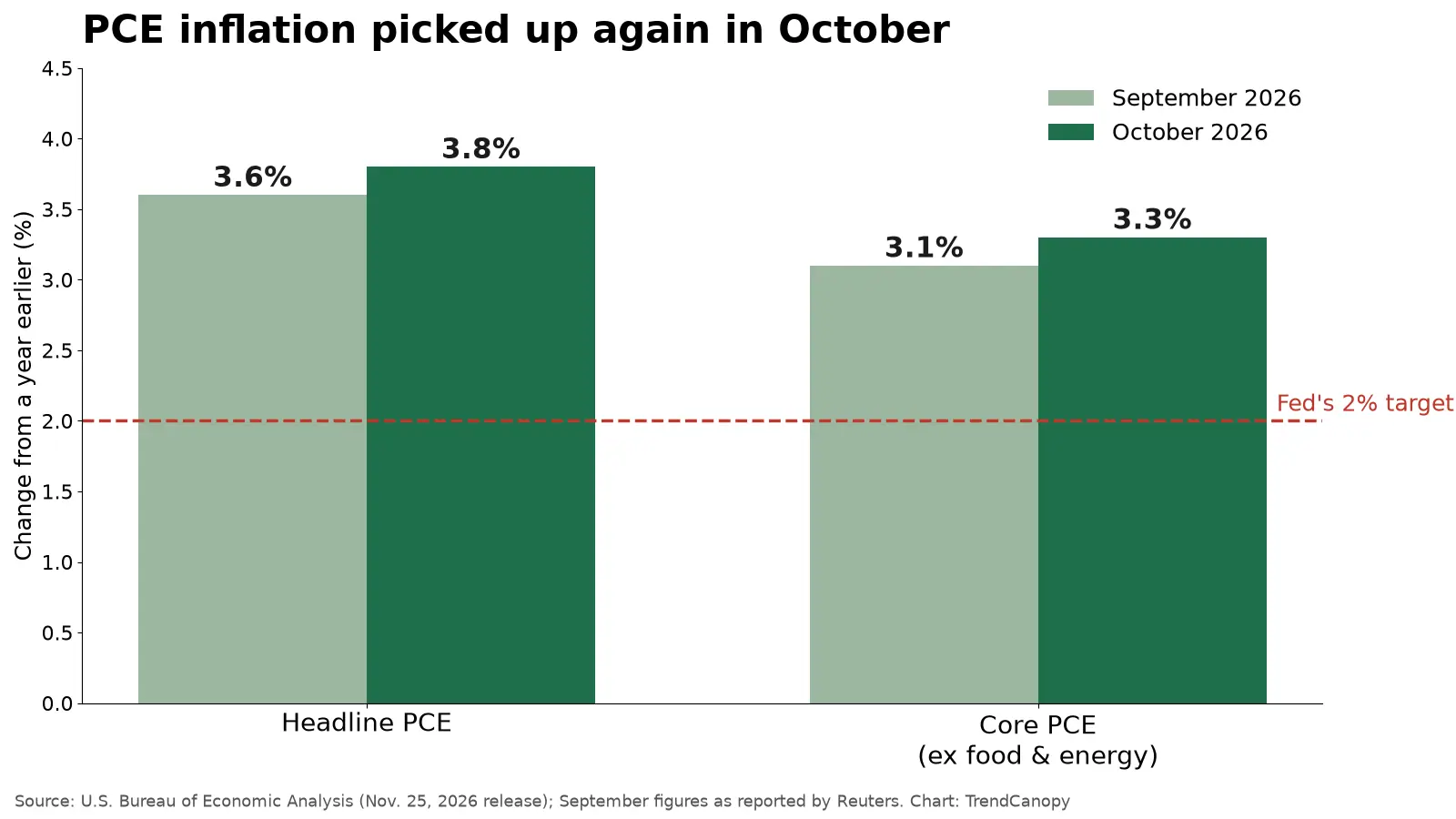
PCE inflation, the price measure the Federal Reserve watches most closely, rose to 3.8% in October from a year earlier, the Commerce Department said Wednesday, Nov. 25, 2026. Core PCE climbed to 3.3%, a tenth of a point above forecasts. A separate report raised third-quarter GDP growth to a 4.3% annual rate, and traders still expect the Fed to raise rates on Dec. 9.
Key takeaways
- Personal income jumped 0.7% in October, helped by one-time Medicare premium rebate payments, while spending rose a smaller 0.3%.
- After adjusting for inflation, consumer spending slipped slightly in October, by less than 0.1%.
- The GDP upgrade from 3.4% came mostly from business investment in software, the Bureau of Economic Analysis said.
- Traders cut the odds of a third Fed hike by early 2027 to about 1 in 3, from 50-50 on Tuesday, CNBC reported.
In this article
Published Wednesday, Nov. 25, 2026, 9:15 a.m. ET, shortly before the stock market opened. Figures come from the government's 8:30 a.m. releases.
Prices kept heating up in October. The personal consumption expenditures price index, the inflation gauge the Federal Reserve uses for its 2% target, rose 3.8% from a year earlier, the Bureau of Economic Analysis said Wednesday morning. That's nearly double the Fed's goal.
Core PCE, which leaves out food and energy, rose 3.3% over the year. Economists surveyed by Dow Jones had expected 3.2% for core, CNBC reported, while the headline number landed right on forecast.
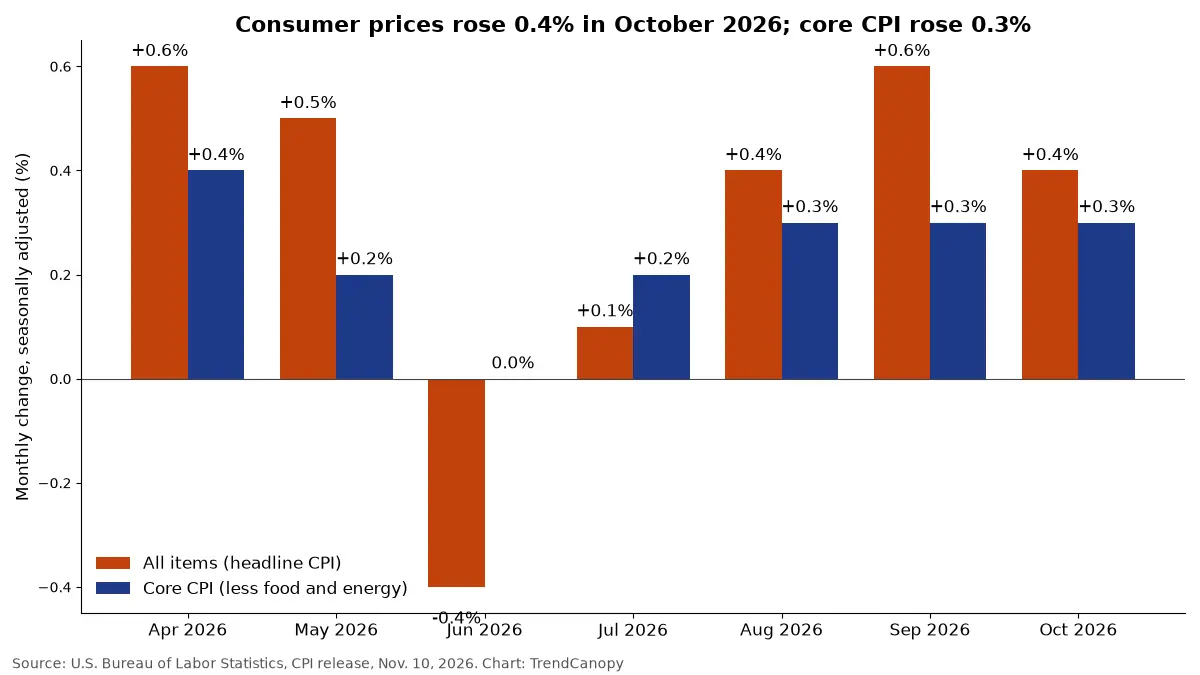
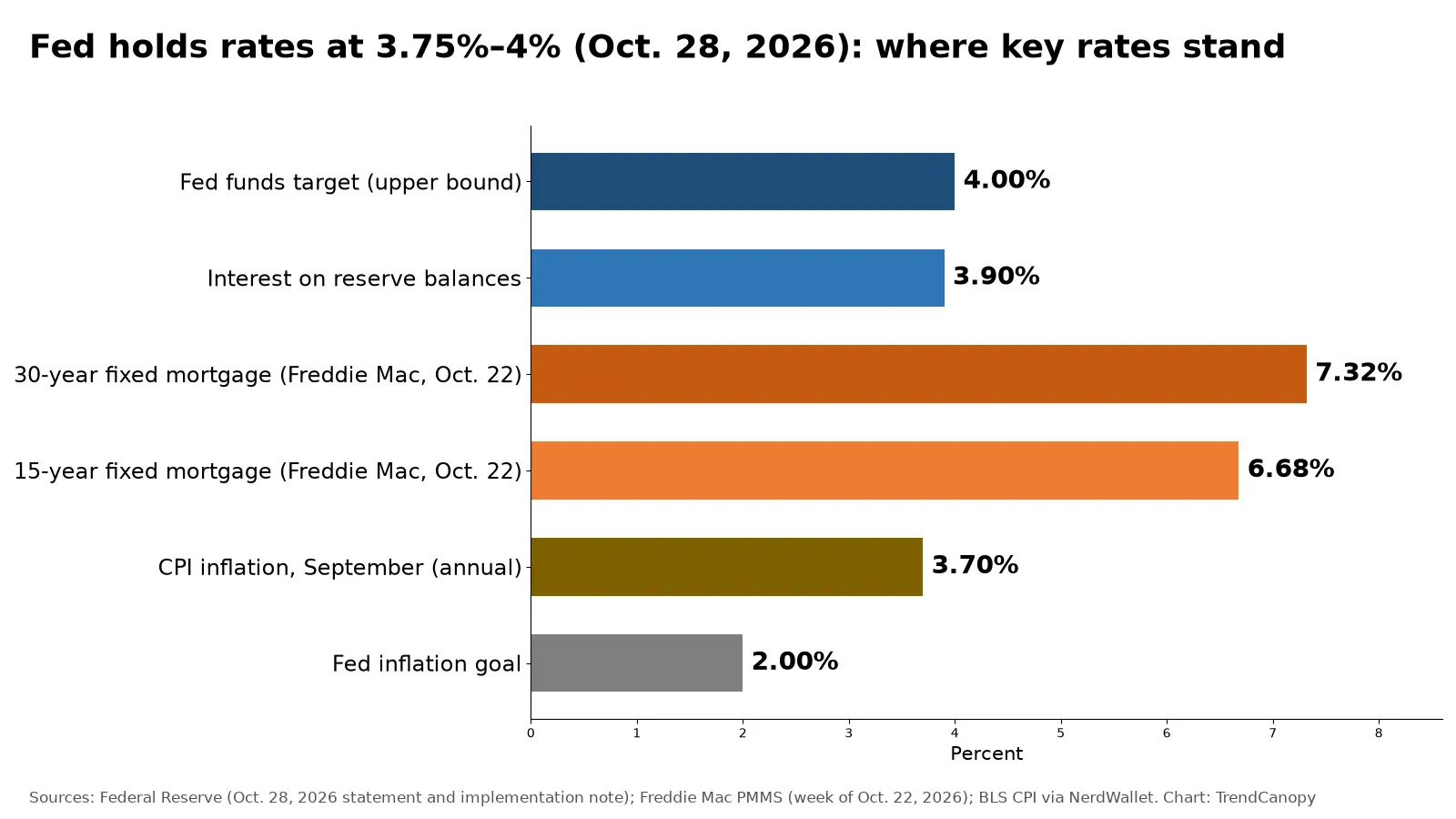
Read also: Consumer prices rose 0.4% in October, hotter than economists expected · The Fed holds rates at 3.75%-4% in a 10-2 vote, with Lisa Cook dissenting · The 10-year Treasury yield tops 5.1% as inflation data lifts bond yields
The same morning brought a much stronger picture of the economy itself. Growth in the third quarter was revised up to a 4.3% annual rate, from 3.4%. Put the two reports together and the message to the Fed is hard to miss: demand is running hot, and so are prices.
What the October PCE inflation report shows
On a monthly basis, both the headline and core PCE price indexes rose 0.3% in October. Headline PCE had jumped 0.5% in September, so the month-to-month pace eased even as the yearly rate rose.
According to Reuters, the annual rate was 3.6% in September and core was 3.1%. Each moved up two-tenths of a point in October.
Inflation has now run above the Fed's target for about five and a half years, CNBC said. It had been easing earlier in 2026 before the U.S.- and Israeli-led attacks on Iran in late February pushed energy costs up. Tariffs and heavy spending on artificial intelligence projects have added pressure since.
The tariff story isn't letting up. The White House announced a fresh round of duties on Wednesday, CNBC noted. We covered the plan in our report Trump administration proposes new tariffs on China, the EU and 12 other economies.
Income surged, but spending cooled
Personal income rose $201.8 billion, or 0.7%, in October. Economists had expected 0.4%. The BEA said a big part of the gain in government benefits came from one-time payments tied to the Medicare Improvement Fund premium rebate, so some of that bump won't repeat.
Spending was softer. Consumer outlays rose 0.3%, a tenth of a point under forecasts, after a 0.6% gain in September that was revised up from 0.5%. Services made up about $52 billion of October's $63.8 billion spending increase. Goods accounted for the rest.
Strip out inflation and spending actually dipped. Real PCE fell $5.8 billion, a drop of less than 0.1%. In plain terms, Americans paid more in October but bought slightly less.
With income growing faster than spending, the personal saving rate rose to 4.1%. Reuters noted that higher-income households, buoyed by stock gains before the recent AI-driven selloff, have done much of the spending this year, while inflation eats into wage gains for everyone else.
GDP revised up to 4.3% for the third quarter
The second estimate of third-quarter GDP was the bigger surprise. Real output grew at a 4.3% annual rate from July through September, up from the 3.4% first estimate and nearly double the 2.2% pace of the spring quarter, according to the BEA's GDP release.
Most of the upgrade came from business investment, especially software. The BEA said it raised its estimate for intellectual property products after the Bureau of Labor Statistics revised a software price index. Consumer spending was also marked higher, led by pharmaceuticals, computer software and gasoline, though health care services were revised down.
A measure the Fed watches for underlying demand, real final sales to private domestic purchasers, grew 5.8%. Gross domestic income, which tracks the economy from the earnings side, rose 4.4%. Corporate profits from current production climbed $206 billion in the quarter.
"Inflation is too hot and it will not be brought under control as long as economic demand is also too hot," Chris Rupkey, chief economist at Fwdbonds, told CNBC.
What the PCE report means for a December Fed rate hike
Before the numbers came out, futures markets were already fully pricing a quarter-point increase at the Fed's Dec. 8-9 meeting, CNBC said, citing CME Group's FedWatch tool. That would move the federal funds rate up from its current 3.75%-4% range, where the Fed left it in late October. Our earlier story, The Fed holds rates at 3.75%-4% in a 10-2 vote, with Lisa Cook dissenting, covers that decision.
Wednesday's data didn't change the December bet. Traders still expect another increase in January, Reuters reported. What shifted was the outlook further out. The odds of a third hike fell to about 1 in 3, from roughly even on Tuesday, according to CNBC.
Fed Governor Christopher Waller has said he could back a larger half-point move, Reuters reported. A hotter core reading gives that camp a little more to point to, though markets are still pricing a quarter point.
For households, a hike would mostly show up in variable-rate debt. Credit card APRs and home equity lines usually follow the Fed's benchmark within a billing cycle or two. Fixed mortgage rates track longer-term Treasury yields instead, and those moved lower after the release.
This is the second hot inflation reading of the month. The consumer price index came first, in our report Consumer prices rose 0.4% in October, hotter than economists expected.
How markets reacted before the opening bell
Stock futures, which were already down after the new tariff announcement, added to their losses after the 8:30 a.m. release, CNBC said. Treasury yields fell sharply, and traders trimmed their bets on how many hikes the Fed will need in 2027.
Regular trading begins at 9:30 a.m. ET. It's a normal session today, but Thursday is a market holiday for Thanksgiving, and Friday's session ends early at 1 p.m. ET, so trading volume is likely to be thin.
What comes next
The Fed won't get another big inflation number before it votes. The November CPI report isn't due until Dec. 10, the day after the meeting ends, so this PCE report is the last full inflation reading policymakers will see before they vote.
The BEA's next personal income report, covering November, and its third estimate of third-quarter GDP are both scheduled for Dec. 23 at 8:30 a.m. ET. That final pass will show whether the software investment that drove today's upgrade holds up.
Frequently asked questions
- What was the PCE inflation rate for October 2026?
- The PCE price index rose 3.8% in the 12 months through October 2026, up from 3.6% in September, the Bureau of Economic Analysis said Nov. 25. Core PCE, which excludes food and energy, rose 3.3%. Both measures rose 0.3% from September alone.
- Will the Fed raise interest rates in December 2026?
- Markets expect it. Futures traders were fully pricing a quarter-point hike at the Fed's Dec. 8-9 meeting after the PCE report, according to CNBC, citing CME FedWatch. That would lift the benchmark range from 3.75%-4%. The Fed itself has not announced a decision.
- What was third-quarter GDP growth in 2026?
- Real GDP grew at a 4.3% annual rate from July through September 2026, according to the BEA's second estimate released Nov. 25. That's up from the 3.4% first estimate and from 2.2% in the second quarter. A third estimate is due Dec. 23.
- Is the stock market open today, the day before Thanksgiving?
- Yes. U.S. stock markets keep normal hours on Wednesday, Nov. 25, opening at 9:30 a.m. ET. The NYSE and Nasdaq close Thursday for Thanksgiving and reopen Friday, Nov. 27, for a shortened session that ends at 1 p.m. ET.
Sources
- Personal Income and Outlays, October 2026 · U.S. Bureau of Economic Analysis, Nov. 25, 2026
- GDP (Second Estimate) and Corporate Profits, 3rd Quarter 2026 · U.S. Bureau of Economic Analysis, Nov. 25, 2026
- Fed's preferred inflation gauge accelerated to 3.8% in October, likely sealing rate hike · CNBC, Nov. 25, 2026
- U.S. inflation rises further in October, bolstering odds of successive Fed rate hikes (via The Globe and Mail) · Reuters, Nov. 25, 2026
Tags
- #Inflation
- #PCE
- #GDP
- #Federal Reserve
- #Interest Rates
- #Economy
About the author
Founder and editor
Marcia Reid is the founder and editor of TrendCanopy, where she reviews and edits every story.
Spotted an error? Read our corrections policy or contact us. Last reviewed November 25, 2026.
Related stories

Trending now
Entertainment ·
Puerto Rico's Jennifer Barreto wins Miss Universe as the first mother to take the crownTech ·
Treasury's FinCEN takes some systems offline after unauthorized access in a cyber incidentSports ·
Detroit Lions owner Martha Firestone Ford dies at 101, days before Thanksgiving gameNews ·
Plane crash off Mississippi's Horn Island kills all six aboard, including two boysSports ·
Steelers bench Aaron Rodgers and turn to Mason Rudolph for Black Friday