CPI Report: October Inflation Rose 0.4%, Hotter Than Expected
The October CPI report shows prices rose 0.4% and core CPI 0.3%, both above forecasts. Why there's no annual rate and what it means for a December Fed hike.
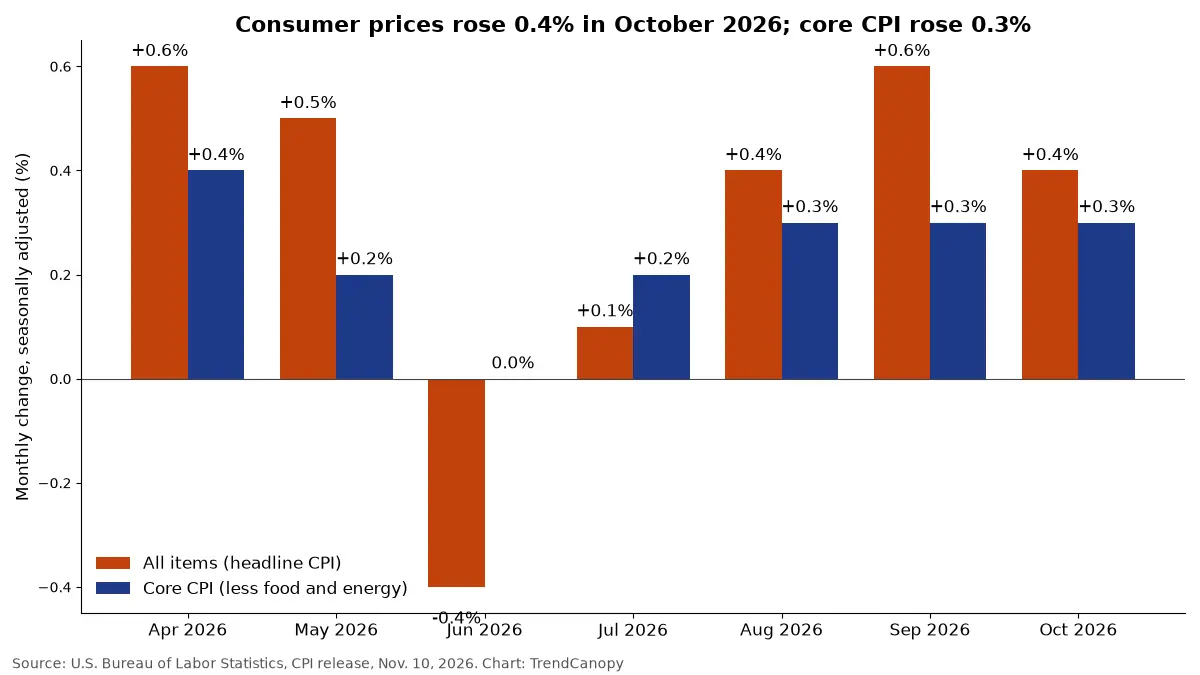
What happened
The October CPI report, released Tuesday, Nov. 10, 2026, showed consumer prices rose a seasonally adjusted 0.4% last month, above the 0.3% economists expected. Core CPI, which leaves out food and energy, rose 0.3% against a 0.2% forecast. Stock futures fell, Treasury yields jumped and traders fully priced in a Federal Reserve rate hike in December.
Key takeaways
- The Bureau of Labor Statistics did not publish a 12-month inflation rate because it couldn't collect October 2025 prices during last year's government shutdown.
- Shelter rose 0.3% and accounted for more than 30% of October's increase. Food rose 0.5%, with beef up 0.9%.
- Used car and truck prices fell 1.2%, one of the few major categories that got cheaper.
- CME FedWatch put the odds of a half-point Fed hike on Dec. 9 at 13.6% after the report, CNBC said.
In this article
Last updated: Tuesday, Nov. 10, 2026, 9:30 a.m. ET. This is a developing story. Regular trading just opened, and we'll update as markets and Fed officials react.
Inflation didn't cool as much as Wall Street hoped. The consumer price index rose a seasonally adjusted 0.4% in October, the Bureau of Labor Statistics said Tuesday morning. Economists surveyed by Dow Jones had expected 0.3%, CNBC reported.
Core CPI, which strips out food and energy, rose 0.3%. The forecast was 0.2%. It's the third straight month core prices have gone up 0.3%.
That's a smaller jump than September's 0.6%. But it was still a miss in the wrong direction, and it landed a day after the market's best rally in months.
What the October CPI report shows
Housing did a big share of the damage. The shelter index climbed 0.3% and made up more than 30% of the overall monthly increase, the BLS said. Rent rose 0.2% and owners' equivalent rent 0.3%.
Groceries and restaurants both got pricier. Food rose 0.5% after being flat in September. Food at home was up 0.4%, with beef up 0.9% and snacks up 1%. Eating out rose 0.5%, and full-service restaurant meals jumped 0.7%.
Energy rose 0.7%, a much smaller gain than September's 5.2% surge. Gasoline was up 1% on a seasonally adjusted basis, though the BLS noted that before adjustment, pump prices actually fell 0.7% in October. Electricity rose 0.9%.
Other categories that went up:
- Recreation, up 0.8%
- Car insurance, up 0.7%
- Hospital services, up 0.8%
- Prescription drugs, up 0.3%
There was some relief. Used car and truck prices dropped 1.2%, and communication fell 0.1%.
Why there's no annual inflation rate this month
If you're looking for the usual "inflation is X% over the past year" number, the BLS didn't publish one. It couldn't collect survey data in October 2025 because of the government shutdown, so for most categories there's no year-ago figure to compare against.
A few items do have 12-month numbers. Gasoline is up 37.4% from October 2025. Used cars are down 3.3%, and new vehicles are up 0.7%.
For context, Reuters reported that annual inflation hit 3.7% in September. Reuters pointed to higher oil prices from the U.S.-Israeli war with Iran and last year's tariffs as the main forces keeping the cost of living up. If you want more on oil, our gas prices explainer covers where prices at the pump are headed.
What it means for a December Fed rate hike
This is the part markets care about most. After the release, traders fully priced in a quarter-point rate increase at the Federal Reserve's Dec. 8-9 meeting, CNBC said, citing CME Group's FedWatch tool. The odds of a bigger half-point move stood at 13.6%.
That talk of a bigger hike didn't come out of nowhere. Overnight, Fed Governor Christopher Waller suggested the central bank should hike next month even if the report was soft, and said a half-point move might be on the table if it came in strong, CoinDesk reported.
"This was the report the market could least afford to see," Karen Manna, fixed income investment strategist at Federated Hermes, told CNBC.
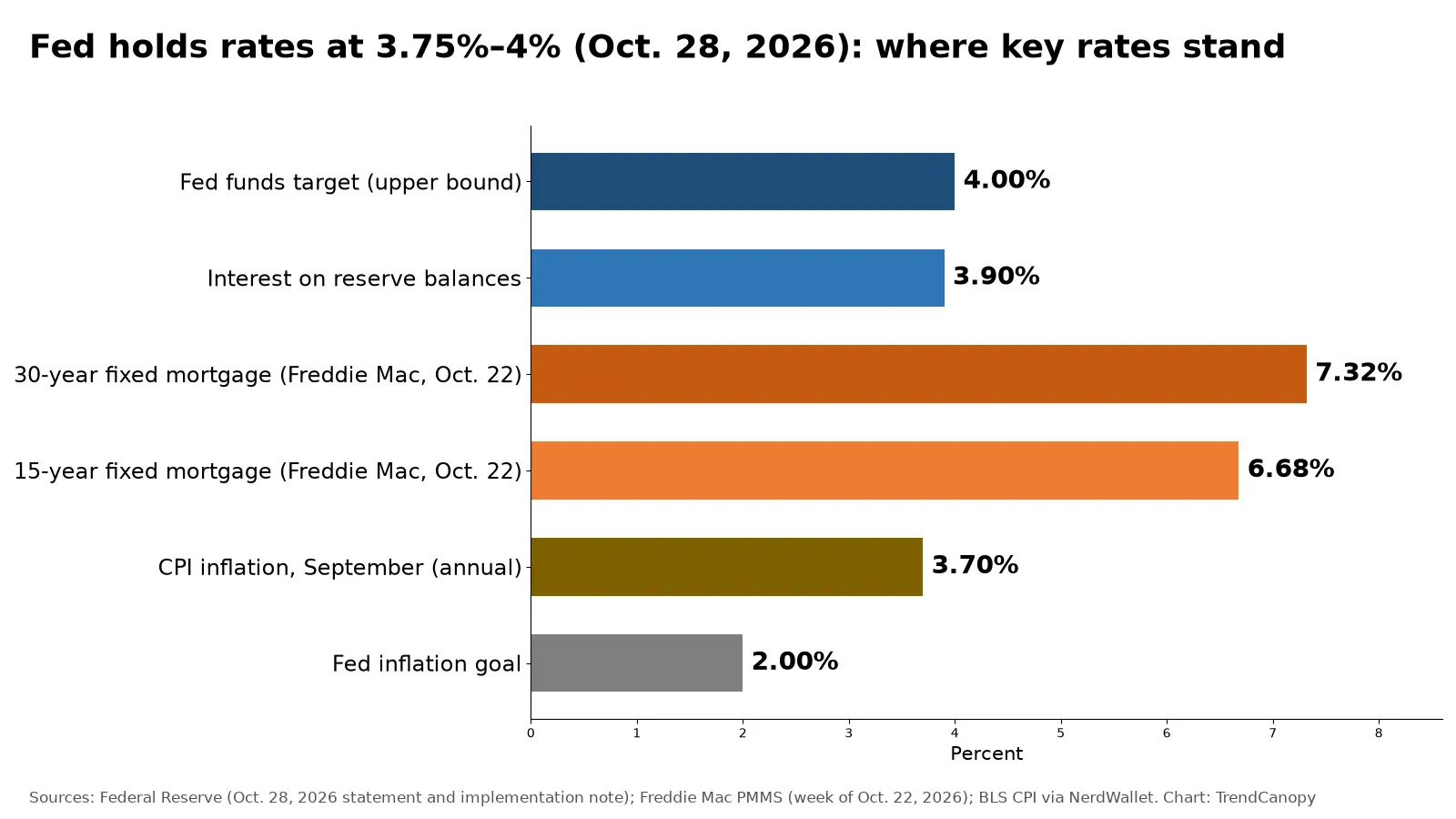
The Fed held its benchmark rate at 3.75% to 4% at its October meeting in a 10-2 vote. We covered that decision in our look at what the Fed's October hold means. A hike would likely mean higher rates on credit cards and other variable-rate loans.
How stocks and bonds reacted
Stock futures slid right after the 8:30 a.m. release. Nasdaq 100 futures were down about 1.15% and S&P 500 futures about 0.5% shortly after, according to CoinDesk, while Dow futures were close to flat. The 10-year Treasury yield rose to about 4.93%, and the 2-year yield jumped about 14 basis points to 4.69%.
Bitcoin dipped to around $73,600, CoinDesk said.
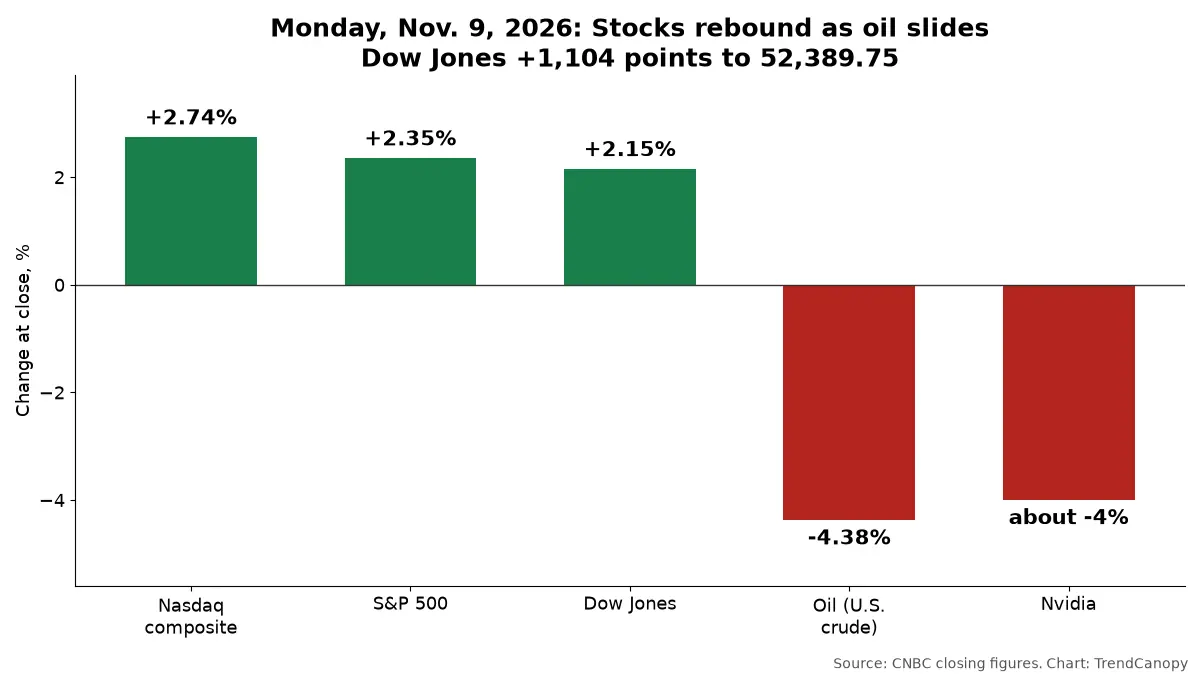
That pullback follows Monday, when the Dow jumped more than 1,100 points as tech stocks bounced back. Here's our story on Monday's Dow rally.
What we don't know yet
We don't know how stocks will close today, and early moves often shift as the session goes on. Fed officials haven't publicly responded to the report yet. The producer price index, another inflation gauge, comes out Friday.
The next CPI report, for November, is set for Dec. 10 at 8:30 a.m. ET. That's the day after the Fed's December decision, so policymakers will vote without it.
Frequently asked questions
- What was the CPI for October 2026?
- Consumer prices rose 0.4% in October 2026 on a seasonally adjusted basis, the Bureau of Labor Statistics said Nov. 10. That was down from 0.6% in September but above the 0.3% forecast. Core CPI rose 0.3%.
- Why is there no annual inflation rate in the October CPI report?
- The BLS didn't collect survey data in October 2025 because of the government shutdown, so it has no base month to compare against for most categories. It published year-over-year figures only for a few items, such as gasoline, which is up 37.4% from a year ago.
- Will the Fed raise rates in December 2026?
- Markets now expect it. After the report, traders fully priced in a quarter-point increase at the Fed's Dec. 8-9 meeting, according to CNBC, citing CME Group's FedWatch. The Fed has not made a decision yet.
- When is the next CPI report?
- The November 2026 CPI report is scheduled for Thursday, Dec. 10, 2026, at 8:30 a.m. ET, one day after the Fed's December meeting ends.
Sources
- Consumer Price Index - October 2026 · U.S. Bureau of Labor Statistics, Nov. 10, 2026
- CPI inflation report: October 2026 · CNBC, Nov. 10, 2026
- US consumer prices rise above expectations in October (via U.S. News) · Reuters, Nov. 10, 2026
- U.S. CPI rose stronger than expected 0.4% in October; core rate rose 0.3% · CoinDesk, Nov. 10, 2026
About the author
Founder and editor
Marcia Reid is the founder and editor of TrendCanopy, where she reviews and edits every story.
Spotted an error? Read our corrections policy or contact us. Last reviewed November 10, 2026.
Related stories
Fed Holds Rates at 3.75%-4%: What It Means for Your Money
The Fed held rates at 3.75%-4% on Oct. 28, 2026, in a 10-2 vote as Lisa Cook dissented. What it means for mortgages, credit cards, savings and a December hike.
CoreWeave Earnings: Stock Jumps After Q3 Revenue Soars 168%
CoreWeave earnings beat forecasts as Q3 revenue hit $3.66 billion and backlog reached $132.5 billion. Why CRWV stock jumped and what still worries investors.
Dow Jones Today: Dow Surges 1,104 Points as Tech Stocks Rebound
The Dow Jones surged 1,104 points Monday to 52,389.75 as tech stocks rebounded and oil fell 4%. Nvidia slid about 4%. Why stocks rose and what's next.
Why Are Tech Stocks Down? The AI Selloff and This Week
Why are tech stocks down? AI spending fears erased about $5 trillion from big AI and chip stocks. Apple, the midterms and the jobs report test markets next.
Eli Lilly Earnings Q3 2026: LLY Stock, Zepbound and Guidance
Eli Lilly's Q3 2026 earnings beat estimates on $24.4 billion in revenue, and Lilly raised its 2026 sales outlook to $91-92 billion. What moved LLY stock.
Anthropic IPO: S-1 Filing, ANT Ticker and $16.29B Revenue
Anthropic filed its S-1 on Oct. 26, 2026, for a Nasdaq IPO under the ticker ANT. The filing shows $16.29 billion in first-half revenue, an $80.7 billion loss, and large compute deals.