Why Are Tech Stocks Down? The AI Selloff and This Week
Why are tech stocks down? AI spending fears erased about $5 trillion from big AI and chip stocks. Apple, the midterms and the jobs report test markets next.

What happened
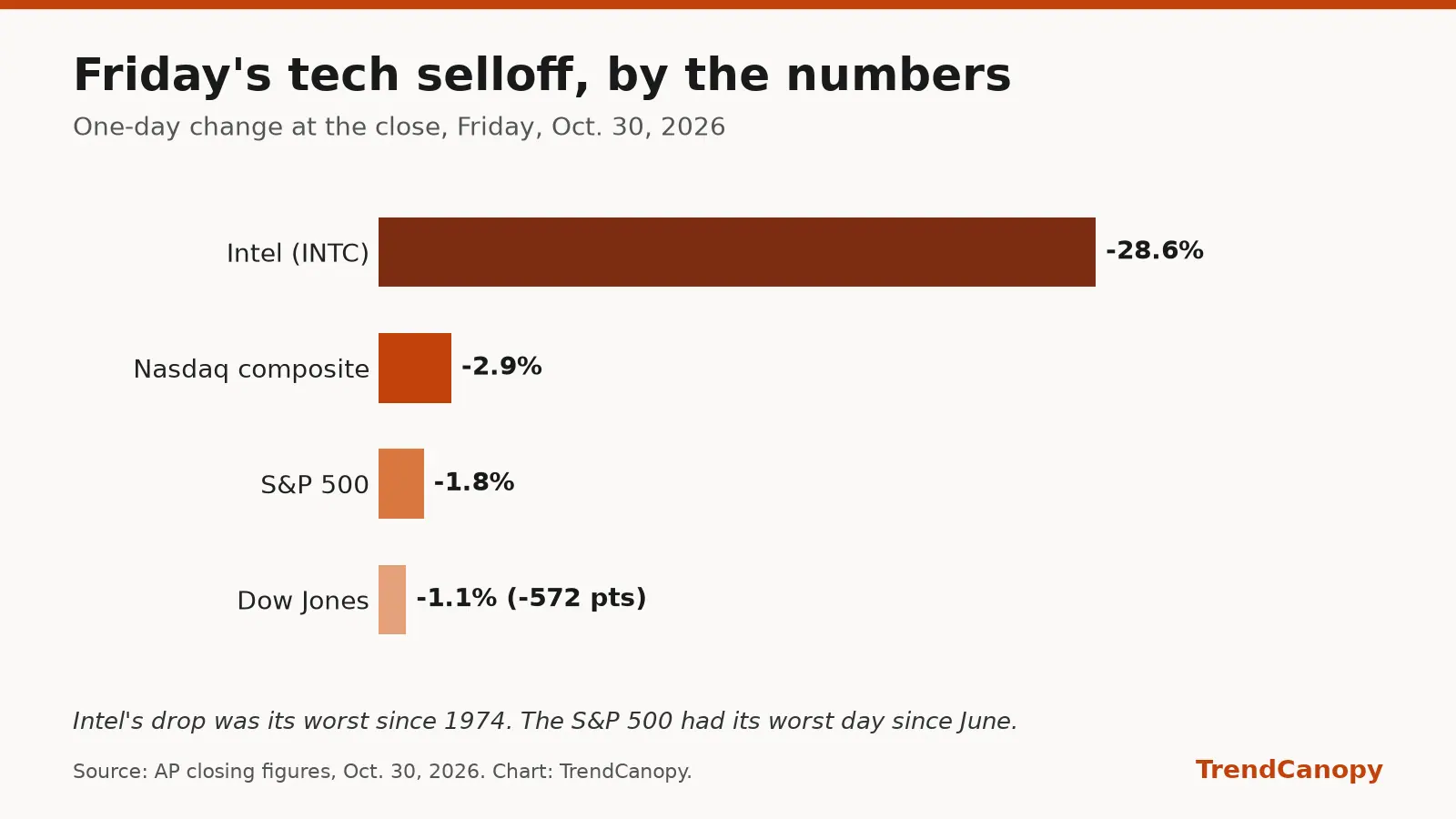
Tech stocks are down because investors have turned on the cost of the AI buildout. The biggest AI and chip stocks lost about $5 trillion in market value between Oct. 6 and Oct. 30, by Yahoo Finance's count, after Alphabet, Amazon and Intel disappointed and Big Tech's spending and borrowing kept climbing. Friday's slide sent the Nasdaq composite down 2.9%, and stock futures rose Sunday night ahead of a week with Apple earnings, the midterm elections and the October jobs report.
Key takeaways
- The damage was narrow: the other 625 large U.S. stocks in Yahoo's tally gained about $1.3 trillion over the same stretch, and 9 of the S&P 500's 11 sectors rose last week.
- Three of the four biggest cloud spenders, Amazon, Meta and Alphabet, reported negative free cash flow for the quarter. Microsoft was the exception.
- Nvidia, the AI trade's bellwether, doesn't report until mid-November, so AMD on Tuesday and Qualcomm and Arm on Wednesday are the chip tests this week.
In this article
October was supposed to be the month AI earnings proved the doubters wrong. Instead, the companies spending the most on AI got hit the hardest, and the rest of the market mostly shrugged.
The short version of why tech stocks are down: Wall Street still believes in AI demand, but it has stopped giving companies the benefit of the doubt on what all that spending costs. The Nasdaq composite lost almost 7% in October, its worst month since the April 2025 tariff rout, Reuters reported. Stock futures bounced Sunday night, but this week is packed with events that could restart the slide or end it.
Why are tech stocks down? It's the AI bill, not AI demand
The odd thing about last week's earnings is that the AI businesses mostly did fine. Amazon Web Services grew 40% to $45.9 billion in revenue. Google's cloud unit brought in $30.7 billion against the $29.1 billion analysts expected. Intel's data center and AI segment jumped 78%, Yahoo Finance noted.
What spooked investors was everything around those numbers.
- Cash burn. Amazon, Meta and Alphabet all reported negative free cash flow for the quarter, according to Business Standard. Amazon's shortfall was close to $35 billion, compared with a small positive figure a year earlier.
- Borrowing. Meta's plan for a record $97.5 billion fundraise raised fears about dilution and about other giants having to tap debt markets, Reuters wrote. Microsoft is reportedly planning its first U.S. investment-grade bond sale in more than nine years.
- Credit stress. The cost of insuring Broadcom's debt against default hit a record, and protection on Alphabet's debt rose as well, Bloomberg data cited by Business Standard showed.
J.P. Morgan estimates $900 billion will go into AI capital spending worldwide in 2026 alone. When the price tag is that large, "good" earnings aren't enough. Evercore ISI analyst Mark Mahaney summed up Amazon's drop as "an expectations correction and not a fundamentals correction."
Alphabet, Amazon and Intel did the damage
Alphabet fell about 13% after missing on revenue and profit, as CEO Sundar Pichai acknowledged AI was cutting into how much money search makes. Reuters called it the stock's biggest one-day percentage drop on record. Amazon missed on both earnings and revenue, and strong cloud growth didn't save it.
Why did Intel stock drop 28%?
Intel's fall was the most dramatic. Shares plunged 28.6% on Friday, the worst day since 1974, AP reported. The company actually beat third-quarter estimates, but its outlook didn't come close: $15 billion to $16 billion in fourth-quarter revenue, against the $17.1 billion analysts wanted, and 25 cents a share in adjusted profit versus 43 cents expected, CNBC reported.
Two problems drove that forecast. PC makers are cutting back because memory chips have become so expensive, and CFO David Zinsner said in Intel's earnings release that he expects the slowdown to last "at least through the first half of next year." An explosion at Intel's plant in Israel, which killed two workers earlier in October, also shut down production of some server chips and will cost about $600 million in revenue over two quarters.
The drop stung in Washington too. The U.S. government took a 10% stake in Intel last year, and CNBC estimated that holding lost about $12 billion in value on Friday.
The selloff was narrower than the headlines
Here's the part that gets lost. By Yahoo Finance's count, the biggest AI and chip names lost about $5 trillion since Oct. 6, while the rest of the large-company market gained. The S&P 500 slipped about 0.6% last week even though most of its sectors were up, a split Yahoo said hasn't happened in any down week since at least 1999.
Apple has been the clearest winner of the rotation. It doesn't pour money into data centers the way its rivals do, and it closed Friday worth about $5.03 trillion, back ahead of Nvidia as the world's most valuable company. If you own a broad index fund, the drop you felt was real, but it came mostly from a handful of very large holdings.
Stock market this week: the dates that matter
These are the scheduled events most likely to move stocks between now and Friday, based on Yahoo Finance's calendar:
| Day | What's coming | Why it matters |
|---|---|---|
| Monday, Nov. 2 | Apple and Palantir earnings after the close | Apple is the market's biggest stock and the one AI-light megacap still rising |
| Tuesday, Nov. 3 | Midterm elections; AMD earnings; September job openings (JOLTS) | Control of Congress, plus the first AI chip report since Intel |
| Wednesday, Nov. 4 | Qualcomm, Arm and Uber earnings; ADP private payrolls | More chip results and an early read on hiring |
| Thursday, Nov. 5 | Weekly jobless claims; Challenger layoffs; Cloudflare and Airbnb earnings | Layoff trends, including in tech |
| Friday, Nov. 6 | October jobs report, 8:30 a.m. ET | The biggest data release of the week for the Fed |
We broke down what Wall Street expects from Apple, and when the call starts, in our Apple earnings preview.
Stock market after the midterms
Voters pick all 435 House seats and 35 Senate seats on Tuesday. Investors are watching a few races for what they could mean for data center construction, including Ohio's Senate race and the Texas governor's race, along with California's Proposition 40, the proposed billionaire wealth tax. Our early voting guide covers how and where to vote.
The historical pattern is a friendly one. From the end of a midterm-year October through the next June, the S&P 500 has gained every time since 1950, Yahoo Finance noted. That's a statistic, not a promise, and Janus Henderson's Seth Meyer pointed out that companies planning AI spending a decade out don't change course over one election.
The October jobs report and the Fed
Friday's report may matter more than Tuesday's results. Economists expect about 55,000 jobs after September's weak 29,000, with unemployment steady at 4.2% and hourly pay up 0.3% for the month. The Fed raised rates in September and held them in late October, and futures still point to a likely hike in December, as we explained in our Fed decision breakdown. A strong jobs number makes that hike more likely, which tends to weigh on expensive growth stocks. A soft one could help them.
Oil is the wild card
Energy prices are adding pressure from another direction. U.S. crude settled above $104 a barrel on Friday, its highest close since mid-September, with the Strait of Hormuz still effectively shut in the ninth month of the Iran war. Prices fell about 3% in early Monday trading in Asia to around $100.58 as talks continued between Iranian and Qatari mediators, Reuters said. Higher fuel costs feed into inflation, and inflation is the main reason the Fed is still talking about raising rates.
What would turn this around
Bulls need two things this week: an Apple report that shows the market can lean on a company that isn't burning cash on AI, and chip results from AMD, Qualcomm and Arm that ease fears after Intel's warning. Goldman Sachs strategist Ben Snider put the problem plainly in a note quoted by Reuters: earnings growth is strong, "but it is no longer accelerating."
That's the real shift. Investors spent two years paying up for the promise that AI spending would turn into profits. October was the month they started asking when. Nvidia's results in mid-November will be the next big answer, and the jobs report and Fed outlook will decide how much patience the market has until then.
This article is for general information and isn't investment advice.
Frequently asked questions
- Why are tech stocks down this week?
- Tech stocks fell because investors are questioning whether Big Tech's huge AI spending will pay off soon enough. Weak results or outlooks from Alphabet, Amazon and Intel in late October, plus rising borrowing by cloud giants and higher costs to insure their debt, drove the Nasdaq to its worst month since April 2025.
- Why did Intel stock drop so much?
- Intel fell 28.6% on Oct. 30, 2026, its worst day since 1974, after forecasting fourth-quarter revenue of $15 billion to $16 billion against Wall Street's $17.1 billion. It blamed a PC slowdown caused by soaring memory prices and an explosion at its Israel plant that will cost about $600 million in revenue.
- What happens to the stock market after the midterms?
- History has been kind. From the end of October in a midterm year through the following June, the S&P 500 has risen every time since 1950, Yahoo Finance noted. Past patterns don't guarantee anything, though, and strategists say AI spending and interest rates matter more to stocks right now than the election result.
- When is the October jobs report?
- The Bureau of Labor Statistics releases the October jobs report on Friday, Nov. 6, 2026, at 8:30 a.m. Eastern. Economists surveyed by Yahoo Finance expect about 55,000 jobs added, after just 29,000 in September, with unemployment holding at 4.2%. A strong number would keep a December Fed rate hike in play.
Sources
- Stock futures jump, opening a monster week after a $5 trillion AI wipeout · Yahoo Finance, Nov. 1, 2026
- A big sell-off collides with more Big Tech earnings and a midterm election: What to watch this week · Yahoo Finance, Nov. 1, 2026
- Wall Street drops to its worst day since June after the sell-off for tech stocks deepens · AP News, Oct. 30, 2026
- Nasdaq faces $2 trillion wipeout in October as AI spending fears deepen · Reuters via U.S. News & World Report, Oct. 30, 2026
- Amazon, Intel shares fall after earnings amid AI spending concerns · CNBC, Oct. 30, 2026
- Intel Reports Third-Quarter 2026 Financial Results · Intel, Oct. 29, 2026
- Stocks bounce as Apple earnings near, oil falls · Reuters via Investing.com, Nov. 2, 2026
- Is the AI investment boom losing steam? What is driving the sell-off · Business Standard, Nov. 2, 2026
Tags
- #Stock Market
- #AI Stocks
- #Nasdaq
- #Intel
- #Jobs Report
- #2026 Midterms

About the author
Editorial team
The TrendCanopy editorial team researches what Americans are searching for, checks the facts against primary sources and publishes clear, sourced explainers.
Spotted an error? Read our corrections policy or contact us. Last reviewed November 2, 2026.
Related stories

Anthropic IPO: Key Numbers From the Claude Maker's S-1
The Anthropic IPO filing lists Nasdaq ticker ANT. Here are the revenue, loss, compute deals and governance details from the S-1, and what happens next.
Eli Lilly Earnings Q3 2026: LLY Stock, Zepbound and Guidance
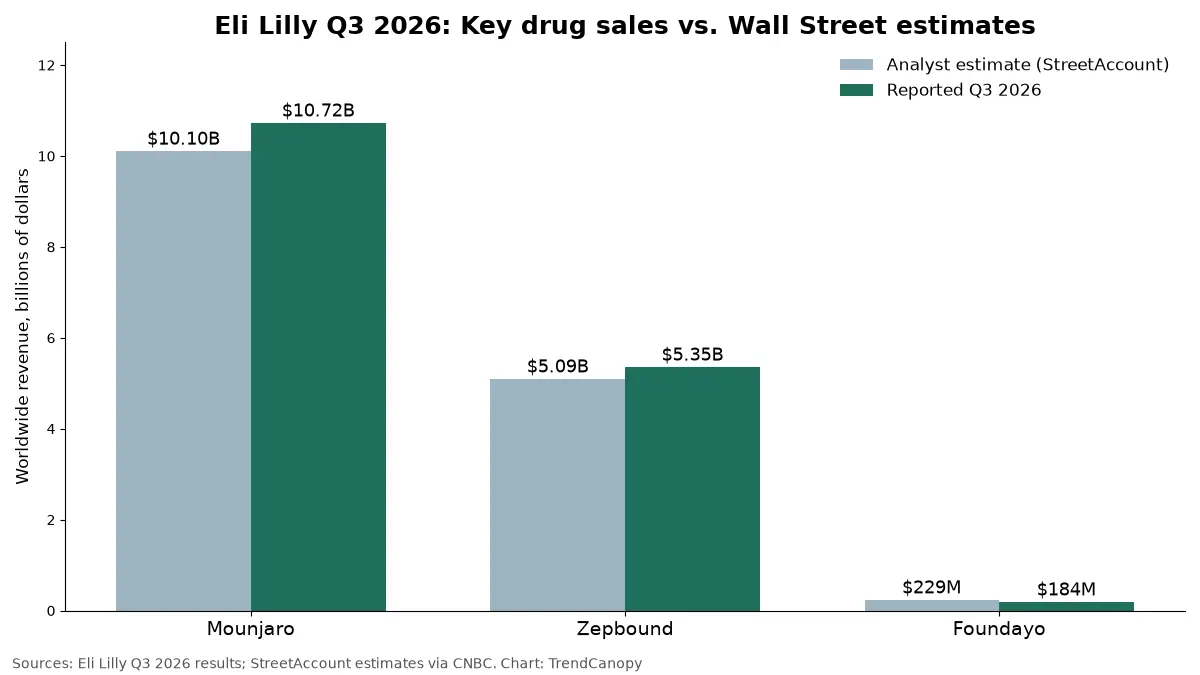
Eli Lilly's Q3 2026 earnings beat estimates on $24.4 billion in revenue, and Lilly raised its 2026 sales outlook to $91-92 billion. What moved LLY stock.
Binance Withdrawals Resume After $6.3 Billion Hack
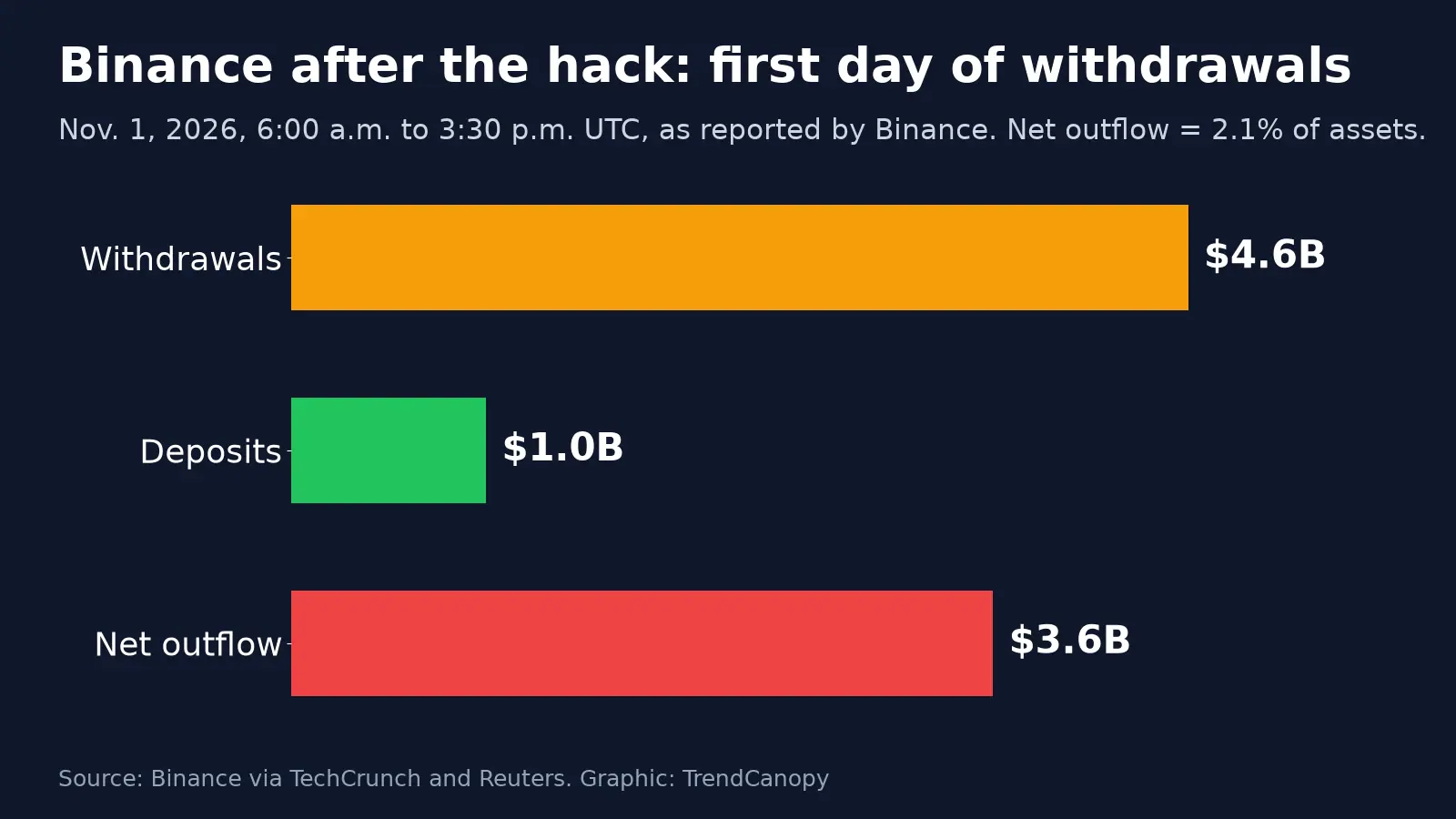
Binance withdrawals are back in phases after the $6.3 billion hack. Which coins work, the $3.6 billion net outflow, what the FBI said and what to check now.