Trump administration readies new tariffs on China, the EU and 14 other economies
New tariffs from a USTR probe into excess factory capacity could land as soon as Tuesday night. The Nasdaq fell 1.5% as tech slid, while the Dow rose.
What happened
The Trump administration is about to propose new tariffs on China, the European Union and 14 other economies after a months-long probe into excess factory capacity, The Wall Street Journal, Reuters and Politico reported Tuesday, Nov. 24, 2026. Politico said the announcement could come Tuesday night. Final rates haven't been published. Tech stocks fell on the reports, with the Nasdaq down about 1.5%.
Key takeaways
- Goods from Mexico and Norway are unlikely to see immediate levies, one person told Reuters.
- Steel, aluminum and autos, already covered by national security tariffs, would be left out, according to the Journal.
- China's rate could rise further if its trade truce with the US, due to end Jan. 10, isn't extended, Reuters said.
- A Reuters/Ipsos poll taken after the midterms found 62% of respondents would back repealing the tariffs.
In this article
Last updated: Tuesday, Nov. 24, 2026, 4:45 p.m. ET. This is a developing story. USTR hasn't released its findings yet, and we'll update this post with the actual rates when it does.
The Trump administration is getting ready to roll out new tariffs on China, the European Union and 14 other economies, a big step toward rebuilding the import taxes the Supreme Court struck down in February.
The Wall Street Journal reported Tuesday that U.S. Trade Representative Jamieson Greer could unveil the results of a months-long probe into foreign industrial subsidies as soon as this week. Reuters, citing three people with knowledge of the matter, said the findings could come as soon as Tuesday afternoon. Politico reported the proposals would be announced Tuesday night.
Read also: Anthropic stock drops more than 10% as the Nasdaq wipes out its gain for the year · The Dow Jones surges 1,104 points as tech stocks rebound from a selloff · Tech stocks slide as an AI selloff wipes about $5 trillion off big names
Neither USTR nor the White House responded to Reuters' questions about the plan.
Who the new tariffs would hit
Greer's office opened the investigation in March under Section 301 of the Trade Act of 1974, which lets the trade representative impose tariffs in response to unfair trade practices. USTR's March announcement named 16 economies: China, the EU, Singapore, Switzerland, Norway, Indonesia, Malaysia, Cambodia, Thailand, South Korea, Vietnam, Taiwan, Bangladesh, Mexico, Japan and India.
The administration argues that government subsidies in those places have built up more factory capacity than their own markets can use, letting companies flood the world with cheap goods. It has singled out China as the biggest offender, pointing to steel, aluminum, electric vehicles, appliances and solar products, Reuters said. China has rejected that, saying its exports reflect competitive advantages.
According to the Journal, as summarized by Investing.com, the duties would cover most products. Steel, aluminum and autos, which already face separate national security tariffs, would be excluded.
What rates are expected
No rates have been published. Here's what the reporting says so far:
- EU, Japan and South Korea: 15% or lower, in line with the trade deals they struck with Washington, the Journal reported. Reuters said Malaysia's deal carries a 19% cap.
- China: the steepest rates, per the Journal. Reuters said the US is expected to honor a 20% cap on Trump's second-term tariffs on Chinese goods if the trade truce that ends Jan. 10 is extended. If it lapses, the rate would go higher.
- Vietnam and India: could face higher duties, the Journal said.
- Mexico and Norway: unlikely to see any immediate levies, one person told Reuters.
The new duties would stack on top of the 10% to 12.5% tariffs imposed in July over forced-labor supply chains, which are being challenged in court. The Journal said the plan may also include triggers that raise rates further if countries don't curb overcapacity.
Ryan Majerus, a former senior Commerce Department trade official now at King & Spalding, told Reuters the administration could propose rates of 15% to 25% on countries found to have excess capacity. He said it might also start lower and build in escalation clauses.
How stocks reacted
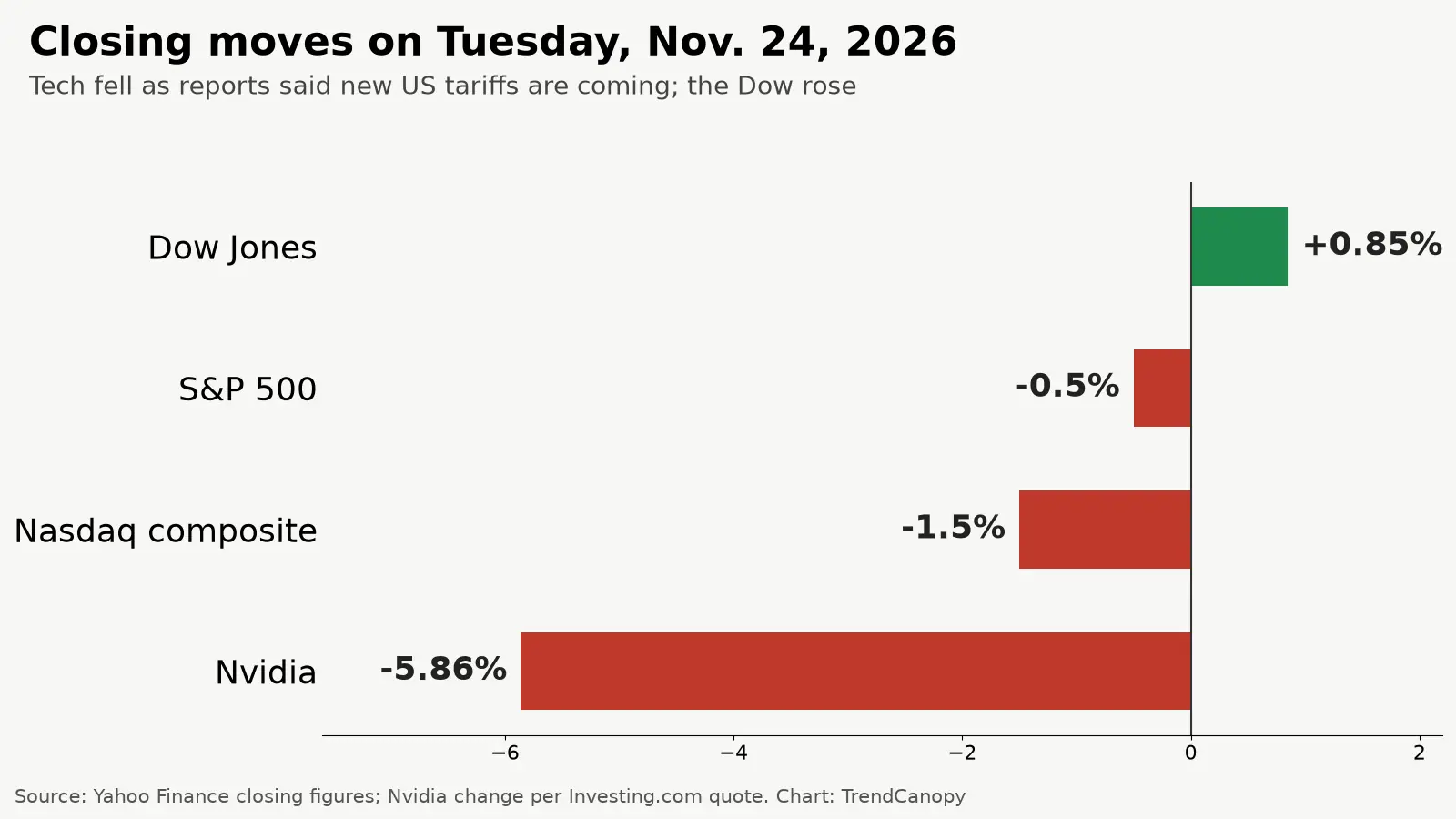
The tariff reports landed on a day when tech was already giving back gains. The Nasdaq composite fell about 1.5% and the S&P 500 slipped about 0.5%, according to Yahoo Finance. The Dow Jones Industrial Average went the other way, rising 423 points, or 0.85%, to 50,018.70.
Nvidia dropped about 6% a day after its 31% jump on Jensen Huang's return as CEO, which we covered in Nvidia reinstates Jensen Huang as CEO, and the stock jumps more than 27%. Micron and AMD also fell.
Reuters said investors were bracing for the new tariffs. "Additional tariffs would add uncertainty to the market," said Gene Goldman, chief investment officer at Cetera Financial Group, who also pointed to Wednesday's PCE inflation report. Traders are mostly pricing in a quarter-point Fed rate hike next month, according to CME Group's FedWatch tool.
What it could mean for prices
Reuters noted the administration's tariffs have partly contributed to higher consumer prices, and a Reuters/Ipsos poll after the midterms found 62% of respondents would support efforts to repeal them. Inflation was already running hot: consumer prices rose 0.4% in October.
A proposal isn't the same as a tariff in force. Section 301 proposals typically go through a public comment period first, so nothing changes at the border until a final action takes effect.
What we still don't know
- The exact rate for each of the 16 economies and which products are covered.
- When any new duties would actually start.
- Whether the US and China extend their truce before Jan. 10.
- How the EU, Japan and other partners respond.
For more on why tech shares have been under pressure, see Tech stocks slide as an AI selloff wipes about $5 trillion off big names.
Frequently asked questions
- What new tariffs is Trump announcing?
- They're proposed import duties on 16 economies, including China, the EU, Japan, South Korea, India and Vietnam, coming out of a Section 301 investigation into excess industrial capacity. USTR hadn't published rates or a product list as of Tuesday afternoon.
- When will the new tariffs be announced?
- As soon as Tuesday night, Nov. 24, according to Politico. Reuters' sources said the findings could come as soon as Tuesday afternoon, and the Journal said this week. Proposed duties usually aren't collected the moment they're announced.
- How high will the new tariffs on China be?
- That isn't final. Reuters said the US is expected to honor a 20% cap on Trump's second-term tariffs on Chinese goods as long as the trade truce is extended, and the Journal reported China is set to get the steepest rates.
- Why did the stock market fall today?
- Tech stocks gave back part of Monday's Nvidia-driven rally, and investors braced for the tariffs, Reuters reported. The Nasdaq fell about 1.5% and the S&P 500 about 0.5%, while the Dow rose about 0.85%.
Sources
- White House prepares sweeping new tariffs on China, EU, and dozens of nations (summarizing The Wall Street Journal) · Investing.com, Nov. 24, 2026
- Trump administration set to unveil new tariffs after probe on excess factory capacity, sources say · Reuters, via Investing.com, Nov. 24, 2026
- Trump administration tees up tariff hikes on EU, China, others · Politico, Nov. 24, 2026
- Nasdaq, S&P 500 end lower following Monday's Nvidia-fueled rally · Reuters, via Investing.com, Nov. 24, 2026
- Stock market today: Dow rises, S&P 500 and Nasdaq decline as chip sector tumbles, Nvidia stock falls 6% · Yahoo Finance, Nov. 24, 2026
- USTR Initiates Section 301 Investigations Relating to Structural Excess Capacity and Production in Manufacturing Sectors · Office of the U.S. Trade Representative, March 11, 2026
Tags
- #new tariffs
- #Trump tariffs
- #Jamieson Greer
- #Section 301
- #China tariffs
- #EU tariffs
- #stock market today
About the author
Founder and editor
Marcia Reid is the founder and editor of TrendCanopy, where she reviews and edits every story.
Spotted an error? Read our corrections policy or contact us. Last reviewed November 24, 2026.
Related stories

Trending now
News ·
Kilmar Abrego Garcia leaves the US for Spain under a deal to avoid deportationNews ·
FAA lifts O'Hare ground stop, but a radar outage keeps Chicago flights delayedTech ·
CIA breach exposed unclassified data on an open-source intelligence network, reports sayNews ·
Huawei convicted of trade secret conspiracy and bank fraud but cleared of racketeeringTech ·
TikTok down for tens of thousands of US users as videos and profiles fail to load